
A document of international significance.
Analysis by F. J. Widmar
Trieste, October 23, 2026 – As previously announced to the press, on October 21st the International Provisional Representative of the Free Territory of Trieste – I.P.R. F.T.T. and the Free Trieste Movement – FTM lodged their application seeking the annulment of the 7 April Order of the Italian Supreme Court of Cassation which falsely states that the international Free Port of Trieste is under the sovereignty of the Italian State.
The application has been entered in the General Register (R.G.) of the Civil Section of the Italian Supreme Court of Cassation under No. 23521/2026.
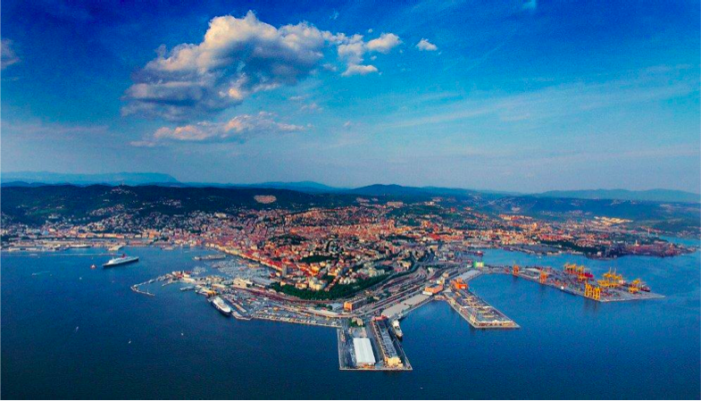
The international Free Port of Trieste.
The international Free Port of Trieste is an extraordinary economic tool for the development of trade through the Mediterranean and through Central Europe up to the Baltic.
It was established by the 1947 Treaty of Peace with Italy, which at Art. 21 directly establishes and recognizes the Free Territory of Trieste as a new sovereign State, ending the previous Italian sovereignty over it (1920-1947).
The Treaty also establishes the international Free Port of Trieste as a State corporation of the Free Territory.
In compliance with the Treaty, starting on 15 September 1947, the Provisional Regime of the present-day Free Territory of Trieste is entrusted to the Governments of the United States and of the United Kingdom (LINK) with all pertinent civil and military powers.
Since 1954, under a Memorandum of Understanding (MoU), the two primary administering Governments have sub-entrusted to the Italian Government (not to the Italian State) the temporary civil administration of the present-day Free Territory of Trieste, including responsibility for maintaining the international Free Port.
The 1947 Peace Treaty and the 1954 MoU are both international instruments in force, implemented in the Italian legal order with laws that take precedence over other laws in force under the Italian Constitution, and the present-day Free Territory has bordered Italy since 1947 and Slovenia since 1992.
This legal status is the same under international law and Italian law and does not, in itself, give rise to a conflict over sovereignty.
The legal dispute.
The legal dispute arises from the conduct of the sub-administering Italian Government, which simulates Italian sovereignty over Trieste to paralyze, for the benefit of Italian ports, the independent functions of the international Free Port and to grant illegitimate port concessions to the People’s Republic of China.
For the latest updates about this situation, see our September 26th analysis “TRIESTE: THE ITALIAN-CHINESE OPERATIONS OVER THE INTERNATIONAL FREE PORT – Political Attack on the Port’s Defenders” (LINK).
The challenged Order.
The strongest confirmation to date of this situation appears in the grounds set out in the application for annulment of the Order with which the Italian Supreme Court of Cassation has falsely declared that the international Free Port of Trieste is under the sovereignty of the Italian State.
Indeed, those reasons confirm that the false claim of sovereignty has only been possible because of the ongoing refusal (2017-2026) of Italian judges to determine and enforce the laws in force, and even because of their refusal to examine the documentary evidence lodged by the complainants.
Furthermore, the same judges imposed burdensome court fees on the complainants with the declared goal of forcing them to give up on their quest for justice.
And the case file shows that the judges were formally asked to conduct the proceedings in this manner by the sub-administering Italian Government, which is responsible for the challenged violations.
This abnormal refusal of justice has therefore become the clearest evidence of the political nature of the Order in question and the basis for the appellants’ application seeking its annulment.
Indeed, in practice, the Order does more than confirm, without evidence, the political propaganda circulated in Italy after the Peace Treaty to paralyze Trieste’s new strategic role and that of its international Free Port, as well as the consequent rights of its people, of all States, and of their enterprises.
For these reasons, a full and direct review of the application for annulment is a matter of legitimate public interest.
We are publishing here, in the form prescribed by law, the full text of the Italian application (LINK) and its official English version (LINK).
Why seek annulment of the Order.
The decisions of domestic Courts, no matter the o rder or instance of judgment, cannot legally affect international Treaties and Agreements.
At this point, it is necessary to clarify why the application seeks annulment of an Order of the Italian Supreme Court of Cassation that falsely asserts the legal status of the international Free Port of Trieste, even though it cannot change that status.
The application for annulment is necessary because the Italian provisional administration is using that deceptive Order to continue its violations of the legal status of Trieste and of its international Free Port.
And these violations cannot be ignored, because they are strategically significant for the following main reasons:
– violation of international obligations and rights established and regulated by international Treaties and Agreements in force;
– violation of the sovereignty of a State-port established, recognized, and protected under a multilateral Peace Treaty in force;
– violation of the civil, political, economic, and fiscal rights of the people of that State (citizens and residents) and of the economic and fiscal rights of its enterprises;
– violation of an international mandate of temporary civil administration sub-entrusted to the Italian Government by the Governments of the US and of the UK on behalf of the UN Security Council;
– violation of the rights of all States and their enterprises over the international Free Port of Trieste;
– illegal activities aimed at granting concessions in the Free Port for the benefit of certain countries, including the PRC, in breach of the control rights granted by the Peace Treaty to the member States of the International Commission for the Free Port;
– active and passive, political and judicial repression of the legitimate defense rights of the damaged parti es;
– corruption in the exercise of the international sub-mandate of temporary civil administration, for the purpose of committing the aforementioned violations;
– violation, through the simulation of Italian sovereignty, of the independence and neutrality of the sub-administered Free Territory, the military defense of which is entrusted, since 1955, to NATO’s Supreme Allied Commander Europe – SACEUR, who, in the role of USEUCOM commander, is at the direct orders of the President of the United States.
The strategic relevance of the aforementioned violations is further aggravated by the fact that they are unprecedented for a Western democratic State that is a member of both the EU and NATO.
Furthermore, the violations concerning the international Free Port may be challenged at any time by any other State or by its enterprises entitled to the rights being violated; those States and enterprises may also join the pending application for annulment (Arts. 105 and 267 of the Italian Code of Civil Procedure).
The main remedies available for the purpose are the international arbitration procedures established by the violated Peace Treaty and the Italian legal procedure for the opposizione di terzo (third-party opposition) seeking the annulment of the challenged Order (Art. 404 of the Italian Code of Civil Procedure).
Court proceedings or out-of-Court settlement.
Our readers can see that, for this reason, the application for annulment also proposes that the sub-administering Italian Government seek an out-of-court settlement through conciliation.
It is evident that in that event the most appropriate mediator would be the Government of the United States, given its role as the primary civil and military Authority in Trieste on behalf of the UN since September 15, 1947.


FREE PORT OF TRIESTE: WE PUBLISH THE APPEAL added by Ufficio Stampa on
View all posts by Ufficio Stampa →